
How Do Invisalign, Fastbraces and Fixed Braces Each Work?
Invisalign uses a series of custom clear aligner trays changed every one to two weeks. Fixed braces use metal brackets and an archwire bonded to teeth for continuous force. Fastbraces uses triangular brackets and a single square nickel-titanium wire to move the crown and root of each tooth simultaneously from the first day of treatment.
Most adults considering orthodontic treatment in 2025 know two of these systems well. Invisalign is the one you see advertised everywhere. Fixed braces are the ones you remember from school. Fastbraces is the one most people have never heard of — and that gap in awareness is exactly where this guide starts.
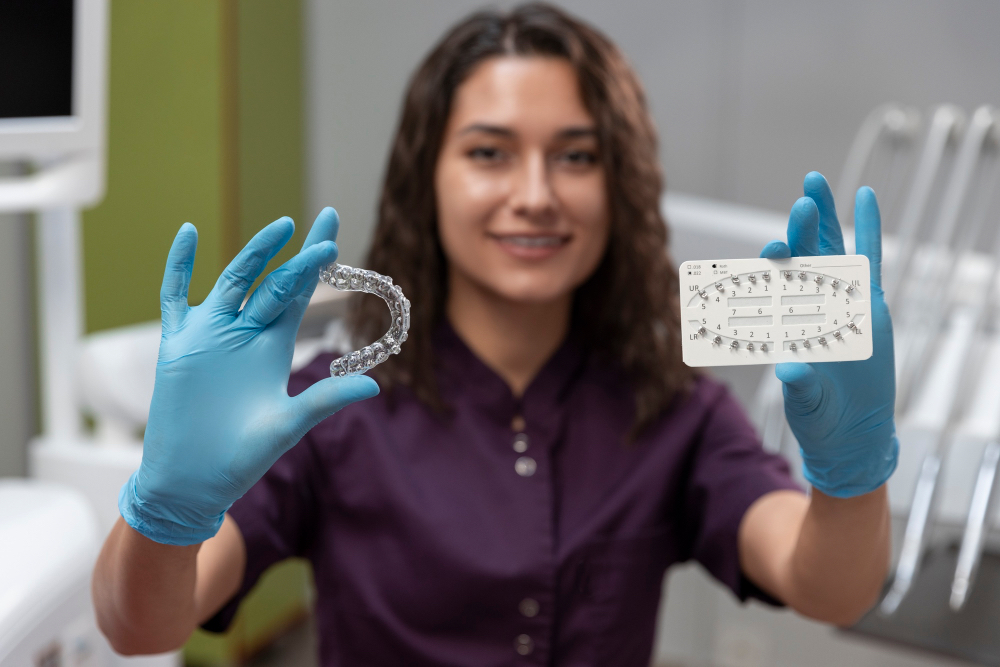
Invisalign is manufactured by Align Technology. Treatment begins with a 3D digital scan of your teeth. The ClinCheck software generates a digital treatment plan showing projected tooth movement from start to finish. Custom thermoplastic aligner trays are fabricated from that plan. Each tray applies gentle targeted pressure to specific teeth. You change trays every seven to fourteen days and collect your next set at monitoring appointments every six to eight weeks. The trays are removable. That is both their greatest advantage and their most significant clinical challenge.
Fixed braces bond metal or ceramic brackets directly to tooth surfaces. An archwire threads through each bracket. The orthodontist adjusts wire tension every four to eight weeks. Between adjustments, the wire applies continuous, passive pressure around the clock. You cannot remove fixed braces. They work whether you think about them or not.
Fastbraces was patented in 1992. The system uses a triangular bracket design rather than the conventional square bracket. The distinction matters biomechanically. Traditional braces move teeth in two distinct phases: the crown of the tooth is moved in the first year, then the root is repositioned in the second year. Fastbraces uses a single square super-elastic nickel-titanium (NiTi) wire inserted through the elevated of each triangular bracket. When triangular brackets replace square ones, the distance between adjacent brackets doubles. Doubling that distance increases the flexibility of the wire by eight times — a direct consequence of wire mechanics physics. That increased flexibility allows the system to apply torquing and tipping forces to the root from the first day of treatment, compressing two movement phases into one.
Fastbraces is offered by a relatively small number of practices in the UK. One Two Three Dental in Guiseley, Leeds, is one of the providers offering all three systems Invisalign, Fastbraces, and fixed braces under one roof, which allows clinical recommendations to be made based on suitability for the individual patient rather than on which system happens to be available.
One important note before moving forward: the British Dental Journal has noted that while the low-friction biomechanics of Fastbraces brackets are documented, peer-reviewed independent research on treatment speed is less extensive than for Invisalign and fixed braces. Clinical outcomes depend on case selection, operator experience, and individual patient biology. The mechanism is genuinely distinct. The speed advantage applies specifically to appropriate cases selected by an experienced practitioner.
How Long Does Treatment Take With Each System?
Invisalign averages 18 months for mild to moderate cases. Fixed braces average 24 months. A peer-reviewed study published in the Journal of Pharmacy and Bioallied Sciences (PMC, 2024) confirmed both figures with statistical significance. Fastbraces treats suitable mild to moderate cases in as little as 3 months to approximately one year. Complex cases take longer with any system.
The 2024 PMC study followed 200 patients over five years and compared long-term outcomes between Invisalign and fixed braces. Invisalign averaged 18 months. Fixed braces averaged 24 months. The difference was statistically significant at p less than 0.001. Both systems achieved 88 to 90 percent success rates in malocclusion correction — comparable clinical outcomes achieved over different timelines.
Here is the number that most Invisalign marketing leaves out. Clinical data from over 112,000 patients confirms that 20 to 22 hours of daily wear is required for optimal outcomes. A study published in the American Journal of Orthodontics and Dentofacial Orthopedics found that patients who adhered to the 20 to 22 hour guideline achieved a 95 percent success rate within their projected treatment time. Patients who consistently wear aligners for fewer than 20 hours per day face extended treatment times, more frequent office visits, and potentially less satisfactory final results.
Fixed braces and Fastbraces require no compliance. They apply continuous force regardless of what you do, what you eat, or whether you remember to put anything back in. For patients who travel frequently, work in demanding environments, or know honestly that they struggle with consistent habits, a non-removable system may produce faster real-world outcomes despite its longer average treatment time on paper.
Fastbraces treatment time of 3 months to one year applies to patients whose case complexity is appropriate for the system. Your treating dentist determines case suitability at consultation. No figure from any manufacturer should be treated as a personal guarantee without prior clinical examination.
What Does Each System Cost in the UK?
Fixed metal braces cost £1,500 to £3,000 in the UK. Invisalign costs £2,500 to £5,500 depending on case complexity and provider tier. All three systems require retainers after treatment, adding £150 to £300 to the total cost. Always request a written quote that includes retainer cost before committing to treatment.
The cost data above comes from the Pearlie.org UK orthodontic comparison published in February 2026, which analysed pricing across UK practices.
Invisalign pricing reflects case complexity. Invisalign Express covers very mild cases and starts from approximately £1,500. Full Invisalign Comprehensive for complex cases reaches £5,500 at some practices. Invisalign provider tiers run from Bronze to Diamond Plus. Higher tiers indicate greater case volume and clinical experience with complex presentations. Provider tier is verifiable through the Invisalign provider finder tool online.
Ceramic fixed braces use tooth-coloured brackets for improved aesthetics during treatment. They typically cost £200 to £500 more than metal fixed braces for the same case. Lingual braces, where brackets bond to inner tooth surfaces and remain invisible from outside, range from £3,000 to £8,000 and represent a separate option not covered by this comparison.
NHS orthodontic treatment for adults is generally not available in England. The NHS uses the IOTN (Index of Orthodontic Treatment Need) scoring system to assess eligibility. Most adult cases do not meet the clinical threshold for NHS funding. All three systems discussed here are private treatments.
Three cost questions every patient should ask before treatment starts: What is the total cost including all retainers at the end of treatment? What is the cost of a replacement aligner if one is lost during Invisalign treatment? What happens clinically and financially if teeth do not track as planned and refinement aligners are needed?
Which System Treats the Most Complex Orthodontic Cases?
Fixed braces treat the widest range of case complexity and perform predictably for significant tooth rotations, vertical bite corrections and severe crowding. Both Invisalign and fixed braces achieve 88 to 90 percent malocclusion correction success rates. Fastbraces suits mild to moderate malocclusion in appropriate candidates selected by an experienced practitioner.
The PMC 2024 study found no statistically significant difference in malocclusion correction outcomes between Invisalign at 88 percent and fixed braces at 90 percent when cases of comparable complexity were treated. The two percentage point gap was not clinically meaningful for most case types studied.
Where fixed braces retain a predictability advantage is in movements requiring precise, continuous three-dimensional force application. Rotations above approximately 20 degrees, significant vertical tooth movement including intrusion and extrusion, severe crowding requiring extraction space management, and cases involving skeletal discrepancies respond more predictably to fixed appliances in most published clinical evidence.
Invisalign handles mild to moderate crowding, spacing, anterior crossbites, and mild Class II and Class III bite corrections effectively, particularly when tooth-coloured attachments are used to provide additional grip for more demanding tooth movements.
Fastbraces is clinically appropriate for mild to moderate malocclusion. It is not indicated as the primary choice for severe skeletal discrepancy cases or for movements requiring the three-dimensional precision of a full fixed appliance sequence. The practitioner's clinical assessment at consultation determines whether Fastbraces is the right system for each patient's specific presentation.
The most important sentence in this section: only a clinician who has physically examined your teeth can tell you which system is appropriate for your case. Any practice recommending a system before conducting a proper clinical examination is not meeting minimum standards of care.
What Are the Lifestyle Differences Between the Three Systems?
Invisalign trays are removed for eating and cleaning, offering complete dietary freedom and easier oral hygiene maintenance but requiring disciplined daily compliance. Fixed braces and Fastbraces are non-removable, restrict certain foods and require more thorough bracket cleaning, but apply continuous force without patient effort.
Eating with fixed appliances: Both fixed braces and Fastbraces require avoiding hard, sticky, and crunchy foods that risk bracket debonding or wire damage. Specific examples include hard sweets, popcorn, ice, crusty bread, raw carrots, and chewing gum. A debonded bracket requires an unscheduled repair appointment and can allow tooth drift if left unattended.
Oral hygiene with fixed appliances: Brackets and archwires create additional surfaces where plaque accumulates. Interdental brushing under the archwire and around each bracket is required at every meal. Inadequate cleaning during fixed appliance treatment is a documented cause of white spot lesions — patches of demineralised enamel that remain permanently visible after braces are removed.
Oral hygiene with Invisalign: Remove the trays, brush and floss normally, rinse the trays before reinserting. Clinical studies confirm that Invisalign patients maintain better periodontal health and lower bacterial counts than patients in fixed appliances, a direct consequence of easier cleaning access.
Aesthetics during treatment: Invisalign trays are nearly invisible. Fastbraces and fixed braces use visible brackets — metal or ceramic. Ceramic brackets are less noticeable than metal but visible at conversational distance. For patients in client-facing professional roles or with significant social commitments during treatment, this distinction is worth factoring into the decision.
Appointment frequency: Invisalign typically requires monitoring appointments every six to eight weeks. Fixed braces and Fastbraces require adjustment appointments every four to eight weeks. Both frequencies are manageable for most adults but should be considered alongside work and travel commitments when planning treatment.
What Happens After Treatment With Any Orthodontic System?
All three systems require retainer wear after treatment. The British Orthodontic Society advises retainers should be worn for life. Research confirms that 70 percent of patients who wore retainers for only one to two years needed retreatment ten years later. Stopping retainer wear is the single most common reason for orthodontic relapse.
This is the section of orthodontic treatment that most patients are not told about clearly enough at the start.
The British Orthodontic Society published its position directly on its website: "If you do not wear your retainers, your teeth will go crooked again, and the hard work in wearing the braces will be lost." Simon Littlewood, a consultant orthodontist and BOS spokesman on retention, explained the clinical reasoning: "Now we know there is potential for teeth to keep moving throughout life. It is almost like a normal ageing phenomenon."
Research cited by the British Dental Negligence Team found that 70 percent of patients who wore retainers for only one to two years after orthodontic treatment needed retreatment ten years later. The BOS launched its "Hold that Smile" campaign specifically to address the widespread underestimation of retention requirements among patients completing orthodontic treatment.
The standard post-treatment protocol follows three phases. Full-time retainer wear for the first week after treatment ends. Evening and overnight wear — approximately 12 hours in every 24 — for a minimum of one year. Lifelong nightly or part-time wear after that, at a minimum of two to three nights per week indefinitely.
Three types of retainer are in current UK use. Removable clear vacuum-formed retainers fit over the teeth like a thin tray — the same material as Invisalign trays. They typically need replacing every one to two years with consistent use. Removable Hawley retainers use a wire across the front teeth with an acrylic body — more durable, adjustable, and more visible. Bonded fixed retainers attach a thin wire permanently to the back surfaces of the front teeth — invisible from outside, always working, but requiring careful interdental cleaning and regular checking to ensure secure bonding.
The cost of retainers — typically £150 to £300 per set for removable clear options, £150 to £250 per arch for bonded retainers — must always be included in the total treatment quote before you commit to any system.
How Do You Find the Right Orthodontic Provider for Adult Treatment in the UK?
Verify GDC registration for any dentist offering orthodontic treatment. For Invisalign, check the provider's tier through the Invisalign finder tool. For Fastbraces, confirm the dentist has completed Fastbraces Technologies accreditation training. Request a full written quote including retainer cost before committing to any system.
The GDC (General Dental Council) register at gdc-uk.org confirms every dental professional's registration status and lists any fitness-to-practise concerns. Specialist orthodontists hold postgraduate qualifications in orthodontics and appear separately on the GDC specialist list. A general dental practitioner can legally offer orthodontic treatment including Invisalign and Fastbraces with appropriate training — but is not a specialist. For complex cases, specialist referral provides access to the full range of orthodontic appliances and expertise.
Four questions to ask at any orthodontic consultation before committing: How many cases of this specific system do you complete per year? Can I see before-and-after photographs of cases with similar presentations to mine, taken under consistent lighting? What is the full cost of treatment including all retainers? What is your protocol if teeth do not track as planned during Invisalign treatment?
A practice that cannot answer these questions clearly and confidently at a consultation is not the right practice for your orthodontic treatment.
Frequently Asked Questions About Teeth Straightening for Adults
Can Adults Over 40 Have Orthodontic Treatment?
Yes. Adults over 40 represent one of the fastest growing orthodontic patient groups in the UK. Clinical considerations differ from teenage treatment. Gum health must be assessed and any active periodontal disease treated before orthodontics begins. Bone density in adults is higher, making tooth movement slightly slower than in adolescents. Results are achievable with all three systems for suitable adult candidates. A thorough clinical assessment determines which system and timeline is appropriate for each individual.
Is NHS Orthodontic Treatment Available for Adults?
NHS orthodontic treatment for adults is generally not available in England. The NHS uses the IOTN (Index of Orthodontic Treatment Need) scoring system to determine eligibility. Most adult cases do not meet the clinical threshold for NHS funding. All three systems covered in this article are private treatments. Patients should request a full written cost estimate, including retainers, before starting any private orthodontic treatment.
What Is the Difference Between a General Dentist and a Specialist Orthodontist?
A specialist orthodontist holds postgraduate qualifications in orthodontics and is listed on the GDC specialist list, verifiable at gdc-uk.org. A general dental practitioner can offer orthodontic treatment including Invisalign and Fastbraces following specific accreditation and clinical training, but holds no specialist designation. For mild to moderate cases treated with accredited systems, a trained general dental practitioner is clinically appropriate. For complex cases involving significant skeletal discrepancy or severe malocclusion, specialist referral provides access to the full range of orthodontic appliances.
What Happens If I Lose an Invisalign Aligner?
Contact your practice immediately. Depending on where in the aligner sequence the loss occurs, the dentist may advise wearing the previous tray temporarily, advancing to the next tray, or ordering a replacement. Replacement aligner cost is typically not included in the original treatment quote. Always ask specifically about the replacement policy and associated cost during your initial consultation. Some practices include a limited number of replacement aligners within the treatment fee — confirm this before treatment starts.